

PFAS in Bucks County Drinking Water: How a Whole-House Filter Can Help
The Short Answer
PFAS, per- and polyfluoroalkyl substances, have been detected in drinking water supplies serving communities in Bucks County, particularly in areas near former military installations in Horsham, Warminster, and surrounding townships. The U.S. Environmental Protection Agency established binding maximum contaminant levels for PFAS in drinking water in 2024. NSF-certified reverse osmosis systems and activated carbon block filters are the two independently verified treatment options for reducing PFAS in residential drinking water. Homeowners who want to know what their water contains and how to address it effectively are in the right place.
Mastery Plumbing installs and services residential water filtration systems throughout Bucks County, Allentown, Quakertown, and the Lehigh Valley. Led by licensed master plumber Dan Dunn (PA133897) with 25+ years of water treatment experience, our team provides free on-site water testing and installs NSF-certified filtration systems sized to each home’s needs. Browse our 4.8-star Google reviews, Yelp profile, and Houzz portfolio to see what PA homeowners say about working with our team. Call 267-377-4172 to schedule a free water assessment.
What Are PFAS and Why Are They in Bucks County Water?
PFAS, or per- and polyfluoroalkyl substances, are a family of synthetic chemicals developed in the 1940s for use in industrial and consumer products including non-stick coatings, stain-resistant fabrics, food packaging, and firefighting foam. The chemical properties that make PFAS useful, their stability and resistance to heat, oil, and water, also make them highly persistent in the environment. They do not break down through natural processes, which is why they are sometimes called “forever chemicals.”
The Bucks County area has documented PFAS in drinking water supplies primarily from former military installations where AFFF (aqueous film-forming foam) firefighting foam was used for aircraft fire training and emergency response over several decades. The former Naval Air Station Joint Reserve Base Willow Grove and Horsham Air Guard Station are the best-documented sources in the region. PFAS from these sites migrated into groundwater and reached both private wells and municipal water intakes serving nearby communities. The Pennsylvania Department of Environmental Protection has monitored PFAS in public water systems statewide and maintains current data on detected levels.
What the EPA PFAS Drinking Water Rule Means for Bucks County Homeowners
In April 2024, the U.S. Environmental Protection Agency published the first National Primary Drinking Water Regulations for PFAS, establishing legally binding maximum contaminant levels. The MCLs for PFOA and PFOS, the two most studied PFAS compounds, are set at 4 parts per trillion each. This is a significant tightening from the prior health advisory level of 70 parts per trillion that had been in place since 2016. Public water systems serving Bucks County communities must test for PFAS under this rule and notify customers when levels exceed the MCLs.
The regulation applies to public water systems with 15 or more service connections. Private well owners in Bucks County are not covered by this federal rule and are responsible for their own testing and treatment decisions. The Pennsylvania DEP recommends that private well owners in communities with known PFAS groundwater concerns test their water proactively and consider point-of-use treatment if results show elevated levels.
Which Filters Actually Remove PFAS From Residential Water?
NSF/ANSI 58 Certified Reverse Osmosis Systems
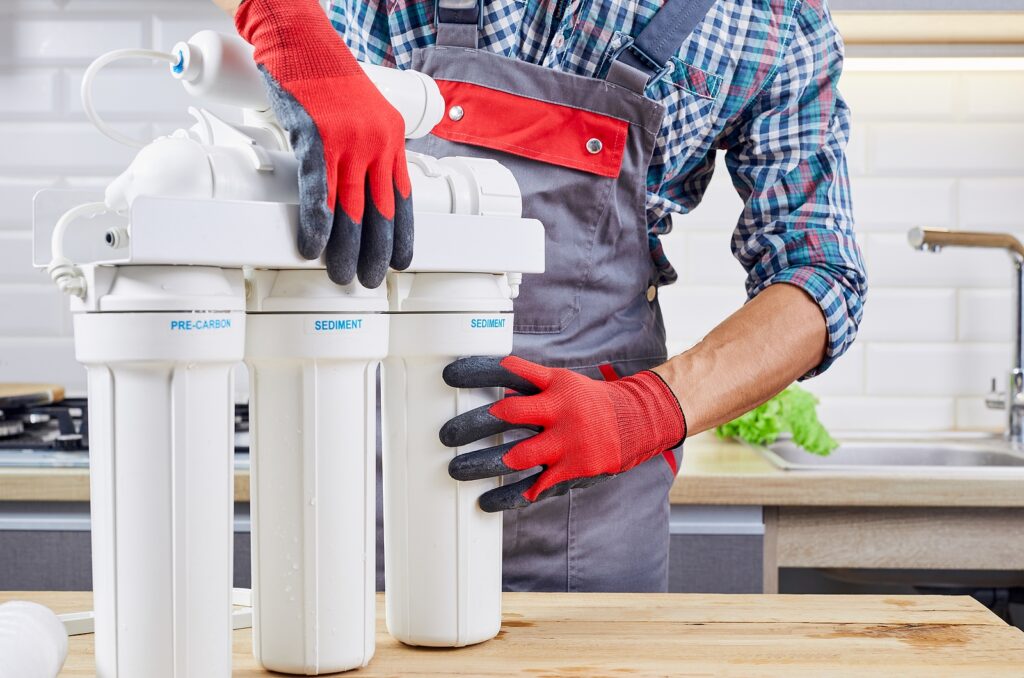
Reverse osmosis systems certified to NSF/ANSI Standard 58 consistently demonstrate high removal rates for PFOA, PFOS, and a broad range of other PFAS compounds in independent testing. An under-sink RO system treats water at the point where it is consumed for drinking and cooking, delivering filtered water through a dedicated tap. For households where documented PFAS in drinking water is the primary concern, a certified RO system under the kitchen sink is the most directly effective treatment option available. Mastery Plumbing installs NSF-certified reverse osmosis systems and services existing RO installations throughout Bucks County and the Lehigh Valley.
NSF/ANSI 53 Certified Activated Carbon Block Filters
Activated carbon block filters certified to NSF/ANSI Standard 53 have demonstrated reduction performance for certain PFAS compounds including PFOA and PFOS. These filters operate through adsorption, binding PFAS molecules to the carbon surface as water passes through. Carbon block filters can be installed as under-sink point-of-use units, inline countertop systems, or as part of a whole-house treatment configuration at the main water entry point. Whole-house activated carbon systems treat every tap in the home, which addresses dermal exposure from bathing in addition to the ingestion pathway addressed by under-sink units.
What Does Not Effectively Remove PFAS
Standard pitcher-type carbon filters sold in grocery stores are generally not certified to NSF 53 or 58 for PFAS removal. Some pitcher filter models have obtained NSF 53 certification for specific PFAS compounds; the NSF mark on the packaging confirms this. Refrigerator water filters are most often certified for chlorine taste and odor but not for PFAS. Water softeners, which use ion exchange to remove hardness minerals, are not designed for PFAS removal and do not provide meaningful reduction of these compounds. If PFAS reduction is the goal, the NSF certification on the specific filter product is the only reliable way to confirm performance.
Whole-House Filter vs. Under-Sink Reverse Osmosis: Which Do You Need?
A whole-house filter installed at the main water entry point treats all water in the home, covering every tap, shower, and appliance. An under-sink reverse osmosis system treats water at a single tap, typically the kitchen drinking water faucet. For PFAS, the primary exposure pathway is ingestion through drinking and cooking water. An NSF-certified under-sink RO system addresses that primary pathway efficiently and at lower installed cost than a whole-house system. For homeowners who want to treat bathing water as well as drinking water, a whole-house activated carbon system provides broader coverage. Mastery Plumbing discusses both configurations and recommends the specification that fits each household’s water quality situation and budget. Our water filter installation and water purification systems cover the full scope of what we install and service.
How to Confirm What Is in Your Bucks County Water
Homeowners on public water supplies can access their utility’s annual Consumer Confidence Report, which is published each July and reports testing results from the prior calendar year. Public utilities testing under the EPA PFAS rule must disclose detected levels in these reports. For private well owners in Bucks County, PFAS testing requires submitting a water sample to a state-certified laboratory. Standard water testing panels often do not include PFAS; a PFAS-specific test must be requested explicitly.
Mastery Plumbing provides free on-site water assessments during consultation visits covering standard parameters. For homeowners who want PFAS-specific testing, we coordinate sample collection and laboratory submission as part of a comprehensive water evaluation. Our well pump and tank service includes water quality evaluation for private well homeowners in Bucks County. For municipal water users, a water softener that addresses hard water alongside a dedicated PFAS filter creates comprehensive treatment for all parameters that commonly affect Bucks County home water quality.
When to Call Mastery Plumbing for Water Filtration in Bucks County
Call 267-377-4172 to schedule a free on-site water assessment. Mastery Plumbing holds Pennsylvania Plumbing License PA133897 and is fully insured and bonded for all water filtration system installations throughout Bucks County, Allentown, Quakertown, and the Lehigh Valley. Our 4.8-star Google reviews and Yelp profile reflect 25+ years of water treatment experience serving PA homeowners. We install NSF-certified systems, provide written test results, and explain every recommendation in plain language before any work begins. Ask about our VIP Care Plans for included annual water system inspections and priority scheduling year-round.
Frequently Asked Questions About PFAS and Water Filtration in Bucks County PA
What are PFAS and why are they found in Bucks County water?
PFAS, per- and polyfluoroalkyl substances, are a group of synthetic chemicals used since the 1940s in products including non-stick cookware coatings, stain-resistant fabrics, food packaging, and firefighting foam. The Bucks County area has documented PFAS detections in drinking water supplies near former military installations, including the former Naval Air Station Joint Reserve Base Willow Grove and Horsham Air Guard Station, where AFFF firefighting foam was used for decades. PFAS enter groundwater through soil infiltration from these sites and can reach both private wells and surface water intakes. The Pennsylvania Department of Environmental Protection has monitored PFAS in public water systems across the state since 2019.
Are PFAS levels in Bucks County drinking water regulated?
Yes. In April 2024, the U.S. Environmental Protection Agency published its first-ever National Primary Drinking Water Regulations establishing maximum contaminant levels for six PFAS compounds. The MCLs for PFOA and PFOS, the two most studied PFAS compounds, are set at 4 parts per trillion individually. Public water systems across Pennsylvania, including those serving Bucks County communities, are required to monitor for PFAS under these federal standards and notify customers if levels exceed the MCLs. The EPA regulation represents a significant shift from previous unenforceable health advisory levels to legally binding limits that utilities must meet.
How do I find out if my Bucks County home has PFAS in its water?
Homeowners on public water supplies can access their utility’s annual water quality report, also called a Consumer Confidence Report, which is published by federal law each July covering the prior year’s testing results. Bucks County utilities required to test under EPA’s PFAS rule must disclose results in these reports. For homes on private wells, PFAS do not appear in public utility reports. Private well testing for PFAS requires submitting a water sample to a state-certified laboratory; Mastery Plumbing can arrange on-site water collection during a service visit. Call 267-377-4172 to schedule a free water assessment for your Bucks County home.
Which water filters are certified to remove PFAS?
Two types of certified filtration systems are most effective for PFAS removal. Reverse osmosis systems certified to NSF/ANSI Standard 58 are the most widely verified treatment option, with testing demonstrating removal of PFOA, PFOS, and several other PFAS compounds. Activated carbon block filters certified to NSF/ANSI Standard 53 have also demonstrated PFAS reduction performance for specific compounds. The NSF certification confirms that the system has been independently tested to meet removal performance claims, not just that the manufacturer makes removal claims. Systems without NSF certification for PFAS should not be assumed to provide meaningful protection.
Does a whole-house water filter remove PFAS?
A properly specified whole-house filter using activated carbon media certified for PFAS under NSF/ANSI 53 can reduce PFAS at every tap in the home. The effectiveness depends on filter media type, contact time, flow rate, and water chemistry. Granular activated carbon (GAC) systems used in whole-house installations reduce certain PFAS compounds but perform less consistently than point-of-use reverse osmosis for PFOA and PFOS specifically. For households with documented PFAS concerns, Mastery Plumbing typically recommends a whole-house carbon filter for general water quality combined with an NSF/ANSI 58 certified reverse osmosis system at the kitchen drinking water tap for the highest level of PFAS reduction where water is consumed.
Does reverse osmosis remove PFAS from drinking water?
Yes. Reverse osmosis systems certified to NSF/ANSI Standard 58 consistently demonstrate high removal rates for PFOA, PFOS, and a broad range of other PFAS compounds in independent testing. An RO system installed under the kitchen sink treats water at the point where it is consumed for drinking and cooking. The system stores treated water in a pressure tank and delivers it through a dedicated tap. Mastery Plumbing installs NSF-certified under-sink reverse osmosis systems and whole-house RO installations for homes with more comprehensive treatment needs. Call 267-377-4172 to discuss which configuration fits your situation.
Will a standard pitcher filter or refrigerator filter remove PFAS?
Standard pitcher-type carbon filters, including popular brands sold in grocery stores, are generally not certified to NSF/ANSI 53 or 58 for PFAS removal. Some pitcher filter models have obtained NSF 53 certification for specific PFAS compounds, and the NSF certification mark on the filter or packaging is the reliable way to confirm this. Refrigerator water filters also vary; most are certified for taste and odor reduction but not for PFAS specifically. For households in Bucks County communities with documented PFAS in their water supply, a professionally installed and NSF-certified treatment system provides more reliable and consistent performance than consumer-grade pitcher filters.
Should I test my water before installing a filter for PFAS?
Testing before installing provides a clearer picture of what your water actually contains and allows the treatment system to be matched to the specific contaminants present rather than specifying a system for a problem that may not exist at your address. For private well owners in Bucks County, testing is particularly important because PFAS concentrations in groundwater vary significantly by location and distance from contamination sources. Mastery Plumbing offers free water testing during consultation visits covering hardness, chlorine, iron, pH, and total dissolved solids, and can arrange expanded PFAS-specific testing through a certified laboratory. Call 267-377-4172 to schedule.
What does NSF/ANSI 58 certification mean for a water filter?
NSF/ANSI Standard 58 is the independent certification standard for reverse osmosis systems. A system certified to NSF 58 has been independently tested by NSF International or a recognized equivalent certification body to confirm that it reduces the specific contaminants listed in its certification to the claimed reduction levels under realistic use conditions. For PFAS specifically, NSF 58 certification means the RO system has demonstrated reduction of the PFAS compounds named in its certification scope, typically including PFOA and PFOS. NSF certification is not self-reported by manufacturers; it requires third-party testing and ongoing audit of manufacturing processes.
Can PFAS affect a private well in Bucks County PA?
Yes. Private well owners in Bucks County communities near former military installations, industrial sites, or areas with documented PFAS groundwater contamination face the same exposure pathway as public water users, without the monitoring and treatment obligations that govern public utilities. PFAS migrate through soil and groundwater and do not degrade naturally, meaning concentrations in affected aquifers can remain elevated for decades after the contamination source is removed. The Pennsylvania DEP recommends that private well owners in communities with known PFAS concerns test their water and consider point-of-use treatment if results indicate elevated levels. Mastery Plumbing serves private well homeowners throughout Bucks County with water testing and filtration installation.
What is the EPA limit for PFAS in drinking water as of 2026?
The EPA’s April 2024 National Primary Drinking Water Rule established MCLs of 4 parts per trillion each for PFOA and PFOS, 10 parts per trillion for PFNA and PFHxS, and 10 parts per trillion for HFPO-DA (GenX chemicals). A hazard index approach governs mixtures of PFNA, PFHxS, HFPO-DA, and PFBS at a combined level of 1. Public water systems must comply with these limits. The prior EPA health advisory levels for PFOA and PFOS were set at 70 parts per trillion; the 2024 rule tightened the standard substantially. These limits apply to public water systems, not to private wells, which are not federally regulated but are subject to Pennsylvania DEP guidance.
How does a whole-house filter differ from a point-of-use filter for PFAS?
A whole-house filter treats all water entering the home at the point of entry, covering every tap, shower, and appliance. A point-of-use filter treats water at a single tap, typically the kitchen drinking water faucet. For PFAS, the relevant exposure pathway is primarily through ingestion of drinking and cooking water. A point-of-use reverse osmosis system under the kitchen sink addresses that primary pathway efficiently and at lower installed cost than a whole-house system. A whole-house filter adds the benefit of treating water used for bathing and laundry, which is a secondary but considered pathway for certain PFAS compounds. Mastery Plumbing discusses both configurations during every water treatment consultation.
How long does whole-house water filter installation take in PA?
A whole-house water filter installation by Mastery Plumbing typically takes two to four hours depending on the system type, the location of the main water entry point, and whether a pre-filter housing, bypass valve, and post-filter pressure regulator are included in the installation scope. Under-sink reverse osmosis installations typically take one to two hours. After installation, the system is flushed and tested to confirm proper flow and filtration function before the technician leaves. Mastery Plumbing provides written documentation of the installed system, filter replacement schedule, and warranty information at project completion.
Does Mastery Plumbing test for PFAS in Bucks County PA?
Mastery Plumbing provides free on-site water assessments covering standard parameters including hardness, pH, chlorine, iron, and total dissolved solids during every consultation visit. For PFAS-specific testing, which requires laboratory analysis, we arrange sample collection and submission to a state-certified laboratory as part of a comprehensive water quality evaluation. Test results are reviewed with the homeowner in writing, and any treatment recommendation is based on what the test shows rather than on a generic specification. Call 267-377-4172 to schedule a free water assessment for your Bucks County home.
What water treatment services does Mastery Plumbing offer beyond PFAS filtration?
Mastery Plumbing provides a full range of residential water treatment services throughout Allentown, Quakertown, Bucks County, and the Lehigh Valley. Services include whole-house carbon filter and sediment filter installation, reverse osmosis system installation and service, water softener installation and repair for hardness reduction, ultraviolet purification systems for bacteria and virus inactivation, and well pump service for private well homeowners. All installations are performed by licensed plumbers under Pennsylvania License PA133897. Call 267-377-4172 or visit our water treatment pages for details on specific services.
Schedule a Free Water Assessment in Bucks County or the Lehigh Valley
Mastery Plumbing (License PA133897) provides free on-site water testing and installs NSF-certified water filtration systems and water purification systems throughout Bucks County and the Lehigh Valley. Call 267-377-4172 to schedule your free water assessment, or ask about our VIP Care Plans for annual water system inspections and priority scheduling. We test first, then recommend. Every installation is backed by a workmanship warranty and full permit management.


